Mount Gorbea
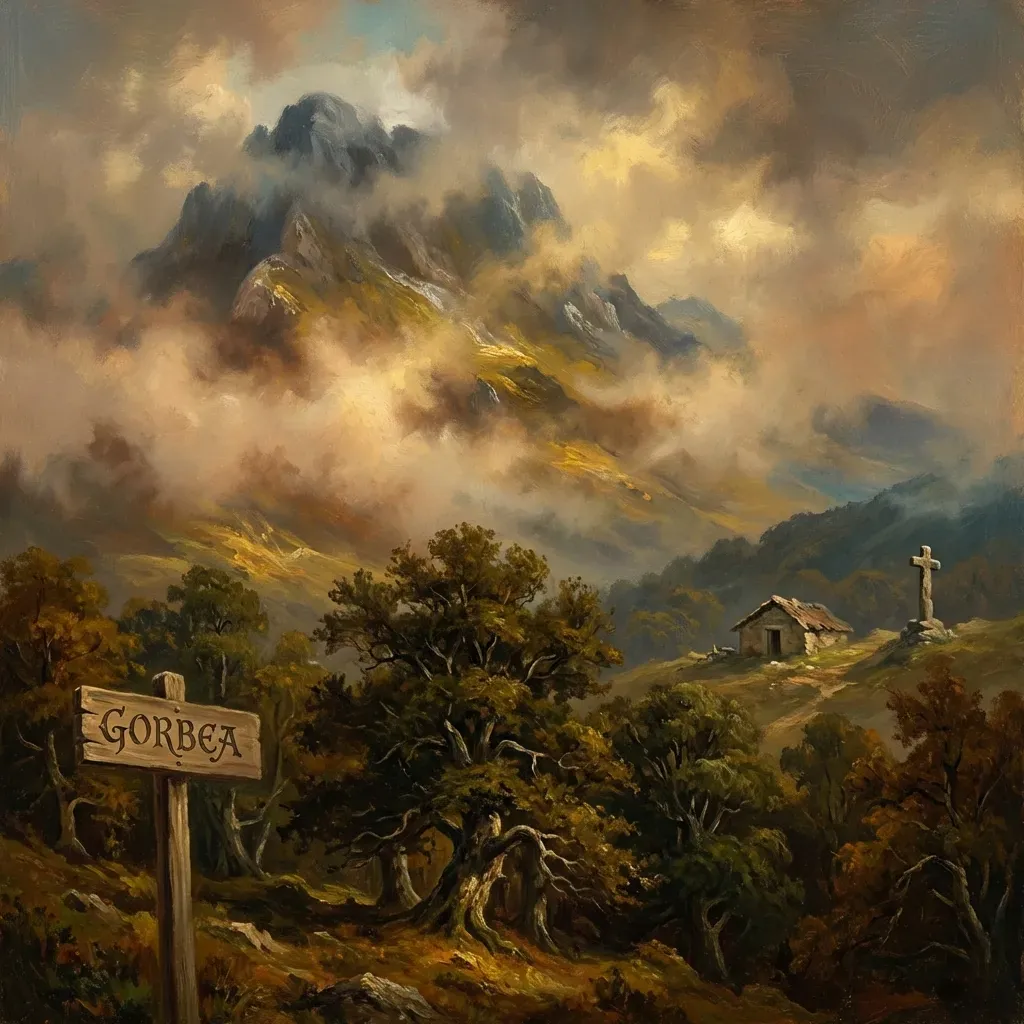
A sacred mountain seen as the heart of Euskal Herria and a symbol of Basque unity.
— Symbol of the shared origin and unity of Euskal Herria —

Aitor is presented as the founding patriarch of the Basque people, a mythical ancestor from whom all Basques would descend. According to the tale created by Agustin Chaho in 1845, Aitor was a primordial leader who guided his people from the East to the lands we now know as Euskal Herria.
The legend says that Aitor established the foundations of Basque society: Euskera as a sacred language, ancestral customs and the values of freedom and independence associated with the Basques. His figure represents the original purity of a people that supposedly kept its essence intact across the centuries.
Although Aitor does not appear in any ancient oral tradition or historical document before the nineteenth century, his creation answered the Romantic need to give the Basque people a founding myth comparable to those of other European nations. The figure took deep root in Basque collective memory.
Today the name Aitor is one of the most popular in Euskal Herria, proof of the success of this literary myth. Even though historians recognize its modern origin, the figure still symbolizes the desire for unity and the sense of a shared origin among Basques on both sides of the Pyrenees.
A sacred mountain seen as the heart of Euskal Herria and a symbol of Basque unity.

The seven historical territories that, according to the myth, would be linked by a common origin.
Within the fascinating branches of Basque mythology, it is essential to pause over figures that, despite lacking a true prehistoric foundation, have powerfully shaped the identity of modern culture. Aitor is the clearest Romantic example of that process.
Many people still believe he is an immemorial patriarch or ancient Basque god, yet the true genesis of the myth leads directly to the nineteenth century and to the political, literary and symbolic needs of that time.
The birth of Aitor is owed entirely to the Basque-French Romantic writer Joseph Augustin Chaho, who in 1845 sought to give the Basque people a grand founding ancestor equal to those of other nations.
Traditionally the word <em>aitor</em> simply pointed to "sons of good fathers" or hidalgos within rural society. Chaho transformed that expression into the name of a primordial patriarch and turned a linguistic misunderstanding into a national epic.
Despite being a nineteenth-century fiction with no trace in older anthropological sources such as Barandiaran, the name took on a real life. Its later popularity shows how literature can create symbols that feel older than history itself.
Aitor therefore belongs to the borderland between myth, politics and cultural desire. He is not ancient in origin, but he has become ancient in emotional weight for many people in Euskal Herria.